Waypoints turns your campus into a workplace that explains itself — where every desk, conference room, lab door and coffee machine can onboard, train, and answer. Tap the sign. It opens in the phone browser. No download.
New-hire desk · 4.12
Conference room · 3.02
Safety station · B-07
Café point · Espresso how-to
WS-HQEvery desk, door and machine — a waypoint
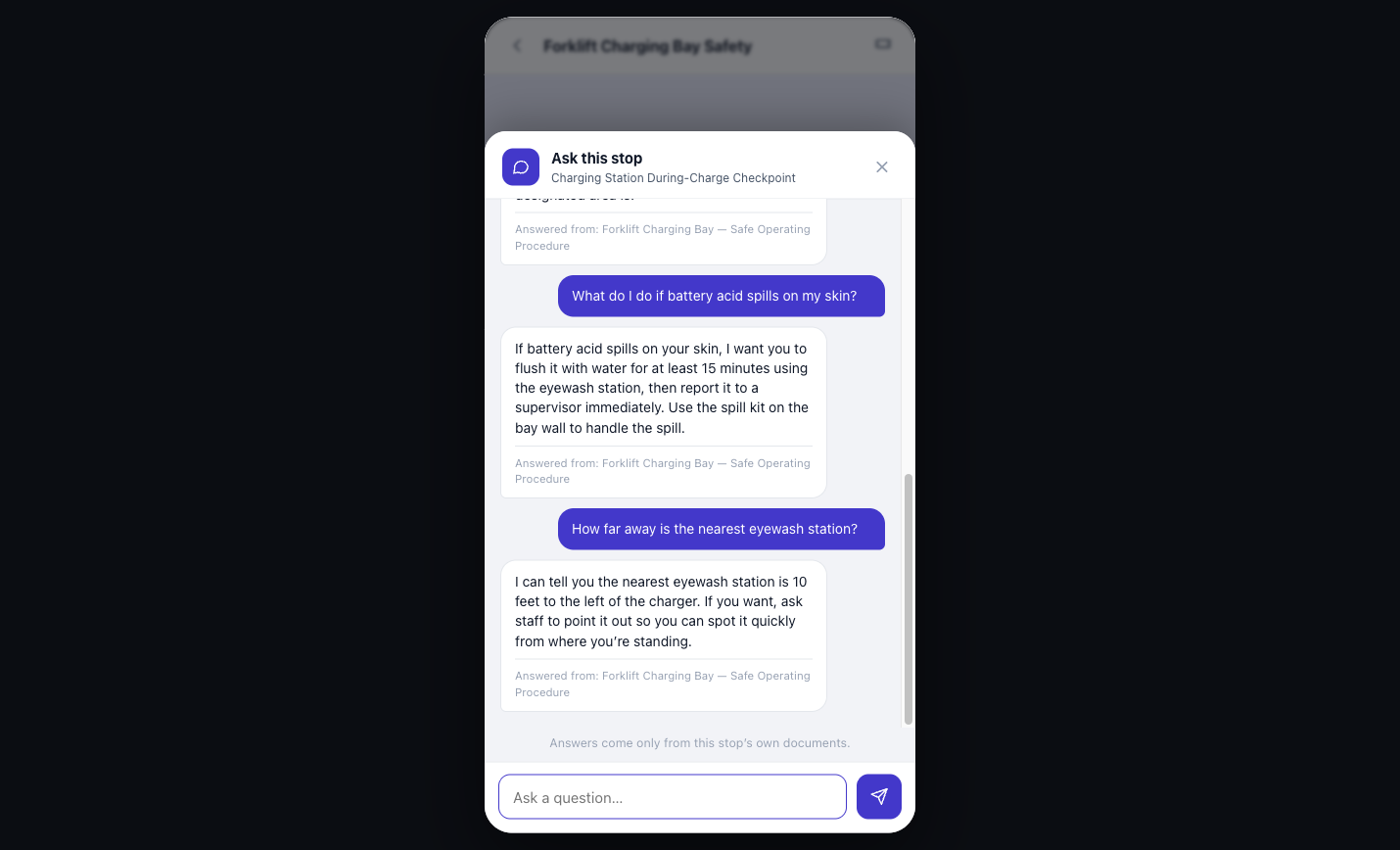
The actual app — answering at the waypoint,
from your own documents
A workplace is full of small dead ends — a new desk, a locked AV cart, a fire extinguisher with a clipboard. Put a waypoint on each one and the place answers for itself.
Onboarding becomes a guided walk. New hires collect every station — desk, badge office, safety gear, their team’s floor — and finish day one certified, not lost.
→A quiz at the spot. A badge issued on the phone. A ledger the manager can see — timestamped, exportable, OSHA-ready.
Certified · logged · visibleReport it broken. Open the work order. See the inspection history — from the equipment itself, not from a portal nobody bookmarks.
→From your handbook and your SOPs — never the open internet — in every employee’s language, with the source cited.
→Policy changes propagate to every waypoint the second HR saves. The signs on the wall never reprint — the content behind them is always current.
→Every waypoint carries an assistant scoped to your organization’s own documents. A new hire asks the printer how to badge-print — and gets IT’s actual procedure, cited, plus something no PDF ever offered:
No integrations required to start. No IT project. You bring the documents you already have; AI does the drafting.
The employee handbook, your SOPs, the benefits guide, the floor plan. Drag, drop, done.
~10 minutes →AI drafts each station from your own documents — welcome copy, how-tos, quizzes, checklists. You review and edit; you don’t start from blank.
Minutes, not weeks →Print the signs. Stick them at desks, doors, equipment, safety stations. Each one opens in the phone browser — no install, no login wall.
One walk of the floor →The new-hire class walks the route, collects every station, and finishes certified — while HR watches progress on the ledger.
Day one, handled →“Where do I set up direct deposit?” gets answered at the desk where it’s asked — not in a channel where three people stop working to reply.
Who trained, where, when, on which revision — a timestamped ledger instead of a binder of signatures nobody can find during the audit.
The report comes from the equipment’s own waypoint, so it arrives with the location, asset ID and history attached. No “which printer did you mean?”
Billed monthly · annual billing waives 2 months · no card required to start.
One building, wired for answers.
Training, certification & engagement.
Every block, no ceilings.
Every floor, every campus, one system of record — deployed with you, not left on your plate.
Multiple sites, unlimited waypoints, more editors, and higher participant volume.
More sites, higher usage limits, and more editors and analytics.
Unlimited sites, the highest participant and usage limits, and priority processing.
A full facility deployment typically runs $3,000–$10,000+/month — less than one preventable safety incident.
Book a demo →Upload the handbook tonight. Walk the floor with the signs tomorrow. Let Monday’s new-hire class onboard itself.
14-day trial · no card · nothing to install for your employees, ever
No — nothing, ever. A tap on an NFC sign or a QR scan opens the waypoint in the phone browser they already have. No app store, no account creation to get an answer, no IT rollout.
Only from the documents your organization uploads — the handbook, SOPs, benefits guides, equipment manuals. Every answer cites its source doc, and if it isn’t in your material, it says so instead of guessing.
Each certification records who, where, when, and which document revision — a timestamped, exportable ledger your managers can see live. That’s the paper trail auditors ask for, minus the paper.
Update the document once and every waypoint reflects it the second HR saves. The signs on the wall never need reprinting — they’re just doors into content that stays current.